
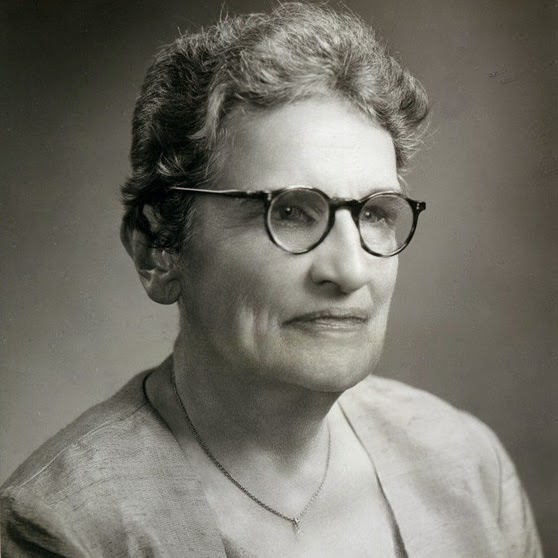
Blind and Teacher of the Blind, Chalkboard Champion Genevieve Caulfield

Our nation’s special education students are truly fortunate to have talented and dedicated teachers working tirelessly on their behalf. One such teacher was Genevieve Caulfield, a teacher for the blind who was, herself, visually challenged.

Genevieve was born on May 8, 1888, in Suffolk, Virginia. When she was only two months of age, she lost her sight when a doctor accidentally spilled a bottle of corrosive medicine over her eyes. A later operation restored some sight to her right eye, but for the rest of her life she saw only shades of gray. Despite her handicap, she taught herself to live like a sighted person, and to be independent and useful.

Genevieve was seventeen years old when an incident involving prejudice and a lack of cultural understanding prompted her to choose a career in teaching. She determined to learn about Japanese culture while helping the blind in their country. It took the persevering  young lady fifteen years to achieve her goal. By then she qualified as a teacher of English, practiced teaching to the blind, and proved she could survive on her own and earn a living.

In 1923, Genevieve traveled to Japan, where she taught English and Braille to blind students. In 1938, after learning that in Thailand, blind children were considered throw-away children, she mastered the difficult Thai language, traveled to that country, and founded the Bangkok School for the Blind, an institution partially financed by her own savings. When World War II ended, the hardworking educator opted to remain in Bangkok and continue her work with her school. From 1956 to 1960, at the invitation of the government of VietNam, Genevieve organized a school for the blind in Saigon. This institution also served as a rehabilitation center for boys.

This chalkboard champion received several honors for her many dedicated years of service. In 1961, Genevieve was awarded the Ramon Magsaysay Award for International Understanding. On December 6, 1963, seventy-three-year-old Genevieve received the Presidential Medal of Freedom in recognition of her work for the blind in Asia. The award was authorized by President John F. Kennedy, but due to the young president’s assassination, the honor was bestowed by President Lyndon B. Johnson. In 1960, Genevieve published an autobiography about her achievements entitled The Kingdom Within.

This remarkable educator passed away on December 12, 1972.

Dr. Gwendolyn Cartledge: She Developed Social Skills Curriculum for Special Education Students

v32n20_cartledgeThe teaching profession is fortunate to boast a large number of educators who are expert at working with special education students. One such educator is Dr. Gwendolyn Cartledge, a former public school teacher who is now a professor in the School of Physical Activity and Educational Services at the Ohio State University.

Gwendolyn earned her bachelor’s degree in elementary education in 1965 and her master’s degree in special education from the University of Pittsburgh in 1973. She earned her doctorate in special education and curriculum and supervision from the Ohio State University in 1975.

After her college graduation, Gwendolyn accepted a position as a teacher in the West Mifflin School District in West Mifflin, Pennsylvania. There she taught elementary students with learning and behavior disorders. While there, Gwendolyn encountered a parent who criticized the special education program, pointing out that the school had failed to teach her son critical social skills. Gwendolyn realized the parent was right. This experience challenged the educator to explore methods to fill this vital need.

After she earned her doctorate, Gwendolyn accepted a position as a faculty member at Cleveland State University where she was a facilitator for teacher inservices for educators who worked with students with mild disabilities. In addition, she consulted with various agencies on developing curriculum. Gwendolyn specializes in methods for teaching social skills to children, both those with and those without disabilities. These social skills include speaking assertively, accepting individual differences, giving and accepting criticism, respecting the property of others, helping others participate, and anger management.

At the Ohio State University, Gwendolyn’s primary responsibilities include teacher education for students with mild disabilities. In addition, this remarkable educator has produced research and writings that are recognized and cited nationally in teacher preparation programs. She has written several books and articles on these topics.

In recent years, Gwendolyn has shifted her focus to the development of social skills in children with learning and behavior disabilities to students enrolled in inner city schools. Her latest book focuses on classroom and behavior management strategies and successful interventions for culturally and racially diverse children with special educational needs.

For her innovative work, Gwendolyn was honored in 2006 with The Educator of the Year Award from the Ohio State Council for Exceptional Children.

Special Education Teacher David Allen Johnson: Chalkboard Champion and Olympic Athlete

Dave-Johnson640[1]Since the Olympic Games in Sochi have dominated the news the past week, now is a great time to honor our chalkboard champions who are also accomplished Olympic athletes. One such individual is David Allen Johnson, a special education teacher from Oregon who earned a bronze medal in the 1992 Summer Olympic Games in Barcelona, Spain.

Dave was born on April 7, 1963, in North Dakota. He grew up in Missoula, Montana, where he attended CS Porter Elementary School, Sentinel High School, and Big Sky High School. In 1980, Dave’s family moved to Corvallis, Oregon. Dave was enrolled in Crescent Valley High School, where he graduated in 1981.

Even as a child, Dave was exceptionally fit and coordinated and lifted weights from a young age. He played Little League baseball and experimented with boxing. During his adolescence, however, Dave was diagnosed with Osgood-Schlatter disease in both knees, a condition that kept him from participating in high school sports. Despite his condition, during his junior high year, he excelled in track, touch football, and basketball.

In his years in high school, Dave admits that he made some bad choices. “Basically, I just didn’t have a lot to do. I just got into trouble,” he once said. “There were ten of us who did things together a lot. We called ourselves the West Side Gang. We didn’t know what we doing. We just wanted to call ourselves something. We had nothing to do.” With these friends, Dave was involved in a series of petty thefts, mostly stealing soda pop and beer from local distributors, but there were also some home burglaries. One of the boys was caught and informed on the rest. When Dave went to the Olympic Games in 1992, he detailed his experiences to reporters, and later used the material for his book and speaking tour as an example on how a teenager could turn his life around.

After high school, Dave enrolled at Azuza Pacific University, a private Christian college located in Azuza, California. While there, he started to compete in decathlon events. At 6’4″, he put his innate abilities and his constant physical training to use and began setting records. Dave became a four-time national champion, and competed in the Olympic trials four times. He earned a berth on the US Olympic Team twice, first in 1988, and then again in 1992. During the 1992 competition, Dave suffered a stress fracture in his left foot on the first day of events. Despite his injury, he put on shoes that were two sizes too big, laced them up tightly, and completed anyway. Astonishingly, he won a bronze medal in the pole vault. Dave retired from competitive sports in 1997.

Dave earned his bachelor’s degree in psychology in 1986, and completed the requirements for his master’s degree in special education in 2003. He accepted his first teaching position in 1998 as a special education resource teacher at Sierra Vista Middle School in Covina, California. In his year and a half there, Dave also served as the Head Coach for track and the Assistant Coach for football. For the next six years, Dave was a special education teacher, Head Track Coach, and Assistant Football Coach at West Albany High School in Albany, Oregon. He then spent two years as an Assistant Principal and Director of Athletics at Jefferson High School in Jefferson, Oregon, followed by a two-year stint as the Athletic Director at South Salem High School in Salem, Oregon. In June 2009, Dave was named as the Athletic Director of  Corban University, a small private college in Salem.

After three and a half years at Corban, Dave left the field of education to become a motivational speaker. He also wrote the autobiographical book Aim High – An Olympic Decathlete’s Inspiring Story, with Verne Becker. This chalkboard champion and Olympic athlete was inducted into the Oregon Sports Hall of Fame in 2005. Currently, Dave serves on the local Salem Keizer Education Foundation Board, raising much-needed funding for schools and teachers. He also does volunteer coaching with his local Salem Track Club, a youth track and field organization.


Teacher Helena Devereux: A Champion for Special Needs Students

71835[1]Special education teachers are no doubt aware of a very remarkable teacher who has contributed much to their field of endeavor. That teacher is Helena Devereux.

Helena was born on February 2, 1885, in Philadelphia, Pennsylvania. Like many young American women of her generation, she became a schoolteacher. She graduated first from Philadelphia High School for Girls in 1904, and then from the Philadelphia Normal School in 1906.

After her college graduation, Helena accepted her first position as a teacher at George Washington Elementary School in the Philadelphia public school system. As a novice elementary teacher working in an underprivileged area of the city, Helena immediately became interested in the children who experienced difficulty in learning through traditional methods. The public school system of her day had no means of providing individualized programs for children with special needs. Rather than helping these students, such children were repeatedly held back, ostracized by their peers, and written off as hopeless. Some were actually sent to mental institutions. Helena showed unique patience and attention to these special needs children. Several such children who had been held back and failed in other classes began to thrive under Helena’s expert care and innovative teaching methods.

Helena began using an individualized approach to the teaching of the developmentally delayed. She believed that each child in her care came complete with his or her own set of innate abilities, distinctive potential, and unique needs. She made it her purpose to aid them in the discovery that each one could be a contributing and valued member of their community and of a larger society. Her methods were groundbreaking, and they pre-dated many of the practices in the field of special education that are typically in use today.

In 1911, the Philadelphia Board of Education offered this remarkable teacher the job of Director of Special Education, a new position designed to supervise the creation of a special education department for the city’s schools. Despite being offered a handsome salary for the time, she turned it down, believing that she could have a greater impact on her own. That same year, Helena received national attention following a visit to her classroom from a reporter who published an article detailing her innovative instructional methods. Following the publication of this article, Helena was contacted by a parent in South Carolina who was interested in entrusting her challenged son to Helena’s care. Helena agreed to assume responsibility for the boy during the summer, and that child became Helena’s first private school student. When Helena received offers from other parents of children with special needs, she responded to these requests by renting a six-bedroom home in Avalon, New Jersey, which she converted to a private school designed to teach and care for the eight children.

In 1924, the gifted teacher Helena married James Fentress, the widower of one of her friends. The couple were married for 21 years, but during all that time, Helena remained dedicated to the students she served. This chalkboard champion passed away on November 17, 1975, at her home in Devon, Pennsylvania, at the age of 90.

Isabelle Salmon Ross: A Pioneer Settler and Pioneer of Physical Education for Women and Special Education Students

22650468_132448519446[1]

Many wonderful teachers were also pioneers in their time. Such is the case of Isabelle Salmon Ross, who was not only a pioneer settler in the Utah Territory in the 1800s, but was also a pioneer of physical education courses for women and special education students during her lifetime.

Isabelle Salmon was born on November 1, 1867, in Perry, Utah Territory. Her parents, William Weir Salmon and Margaret Hay Hunter Salmon, had immigrated from Scotland. Isabelle earned her degree in education at the University of Utah and also attended Harvard University. She became a physical education teacher in the public school system in Salt Lake City, at Brigham Young College, and at the Utah State School for the Deaf and the Blind in Ogden, Utah.

Isabelle was a member of the Church of Jesus Christ of Latter-Day Saints. She served her church in the general presidency of the Primary organization. While working in that capacity, Isabelle met and fell in love with fellow Mormon Charles James Ross. On September 29, 1897, the pair married in the Salt Lake Temple. Her husband was from Ogden and was a member of the general board of the Deseret Sunday School Union. He also served for a time as the manager of Ogden Tabernacle Choir.

In her later life, Isabelle suffered from coronary heart disease, and passed away at the age of eighty on December 28, 1947, in Salt Lake City. She is interred at the Salt Lake City Cemetery.